{{ post.date }}
{{ post.readTime }}

Every main contractor has been there. It is Friday afternoon, a subcontractor’s construction weekly progress report arrives, and it says: ‘Work progressed well on floors 2 and 3.’ That is not a progress report. That is a sentence. And it tells the main contractor absolutely nothing useful.
From the subcontractor’s side, the frustration runs in the opposite direction. They spent an hour pulling information together, writing it up, sending it and nobody responded, nobody seemed to read it, and they still got a call on Monday morning asking for an update.
The problem is not the effort. It is the format. A weekly project progress report only works when both sides agree on what it is for and what it should contain.
Done well, a weekly report does three things for subcontractors: it builds trust with the main contractor, it reduces the number of chasing phone calls by around half and it creates a written record that protects you if a dispute arises over delays or variations. For main contractors, a good report means fewer surprises, better visibility and the ability to spot problems before they become expensive.
This guide gives you the structure, the section-by-section writing guidance, and a free template you can use immediately. (For the fuller picture of how weekly reports fit into overall site reporting, see Remato’s complete guide to construction site reporting.)”
By the end, you will know exactly what to include, how to write each section, and how to make the whole process take less than 30 minutes a week.
Before writing a single word of a report, it helps to understand what the person receiving it actually needs. Most subcontractors write reports from their own perspective – ‘here is what we did this week.’ Main contractors read reports from a completely different perspective: ‘does this tell me what I need to know to manage my project?’
Main contractors aren’t reading your report for the sake of paperwork. They’re using it to answer a few specific questions, fast:
In short: main contractors want a report that’s fast to scan, specific about location and quantity (not just “made good progress”), and honest about problems before they become expensive.
There are four things a main contractor genuinely cares about in a weekly update:
The main contractor needs to know not only what was done, but whether the amount of work completed was sufficient.
When several subcontractors are working across different areas, the main contractor must quickly understand whether each work package is:
A vague statement such as “electrical installation continued this week” provides very little value.
A better update would be:
“Ceiling-light wiring is 65% complete, compared with 55% last week and a planned position of 70%.”
This immediately shows what changed, how actual progress compares with the plan, and whether management attention may be required.
Progress can be shown through:
The key is to make progress measurable.
Main contractors do not necessarily object to problems. Construction projects always involve constraints, changes, and unexpected issues.
What they dislike are surprises.
A blocker identified clearly in a weekly report can often be resolved before it causes serious disruption. The report should explain:
For example:
“Wiring in Rooms 24–26 cannot be completed because the revised ceiling drawings have not been approved. Approved drawings are required by Wednesday to avoid delaying ceiling closure.”
That is far more useful than mentioning the issue verbally after the delay has already occurred.
Problems should be raised early, factually, and with a specific request attached.
The main contractor also needs to understand what resources were available and whether they were sufficient to achieve the reported progress.
Useful information includes:
This information helps the main contractor validate progress claims and understand the reason behind any shortfall.
For example, if a subcontractor reports that only 60% of the planned work was completed, the resource section may show that:
Resource information is also important for coordinating access, planning the following week, and checking whether recovery measures are realistic.
4. Next week’s commitments
A strong weekly report should look forward as well as backward.
The main contractor needs to know what the subcontractor is committing to deliver during the following week.
This should include:
For example:
“Next week, the electrical team will complete ceiling-light wiring in Rooms 24–28 and begin testing in Rooms 21–23.”
The report should also state what is required from the main contractor to make that plan achievable.
For example:
“Action required from the main contractor: approve the revised ceiling drawings by Wednesday and provide access to Rooms 27–28 by Thursday.”
This clear division between the subcontractor’s commitment and the action required from the main contractor is what turns a basic status update into a useful project-management tool.
What main contractors do NOT want
Padding and filler language (‘the team continued to work diligently’)
Walls of text with no structure or headings
Missing dates, quantities, or completion percentages
No mention of problems, even when problems clearly exist
Reports sent late
A weekly construction progress report should be readable in under three minutes. That means clear sections, specific language, and no unnecessary content. The following six sections cover everything a main contractor needs, in the order they expect to read it.
Start with the basic information needed to identify and file the report.
Include:
Manual: Filled in by hand at the top of the report each week.
Digital: Auto-filled from the project record — no retyping the same header every week.
List the work completed during the reporting period. Tie each activity to a specific location and include quantities where possible.
Include:
Manual: A short list tied to specific locations and quantities — e.g. “Level 3, Zone B: 40m of first-fix electrical containment installed.”
Digital: Logged through a jobsite diary as the work happens through the week, so the report is a summary of real entries rather than something reconstructed from memory on Friday afternoon.
3. Work Planned for Next Week
Include:
Manual: Written out so the main contractor can plan access and coordination.
Digital: Pulled directly from your task list/schedule inside the platform, so “planned” work is linked to actual assigned tasks rather than a free-text guess.
4. Manpower, Equipment & Materials on Site
Include:
Manual: Counted and logged manually at the end of the week.
Digital: Where crew time is tracked digitally (for example with GPS-based clock-in/out, as in tools like Remato), manpower numbers come from actual attendance data instead of an estimate, and tool location can be tracked automatically via QR scanning.
5. Issues, Delays & Risks
Include:
Manual: Written up once a week, often after the fact.
Digital: Flagged in real time as they occur (via task comments or chat) rather than batched up once a week, so the main contractor sees the issue days earlier.
6. Photos & Site Documentation
Include:
Manual: Attached to the report or emailed alongside it, labelled by hand.
Digital: Photos are automatically timestamped and geotagged, which removes the labeling work and creates a documentation trail that’s harder to dispute later.
Download a free construction weekly progress report from:
or start with digital construction reporting: HERE
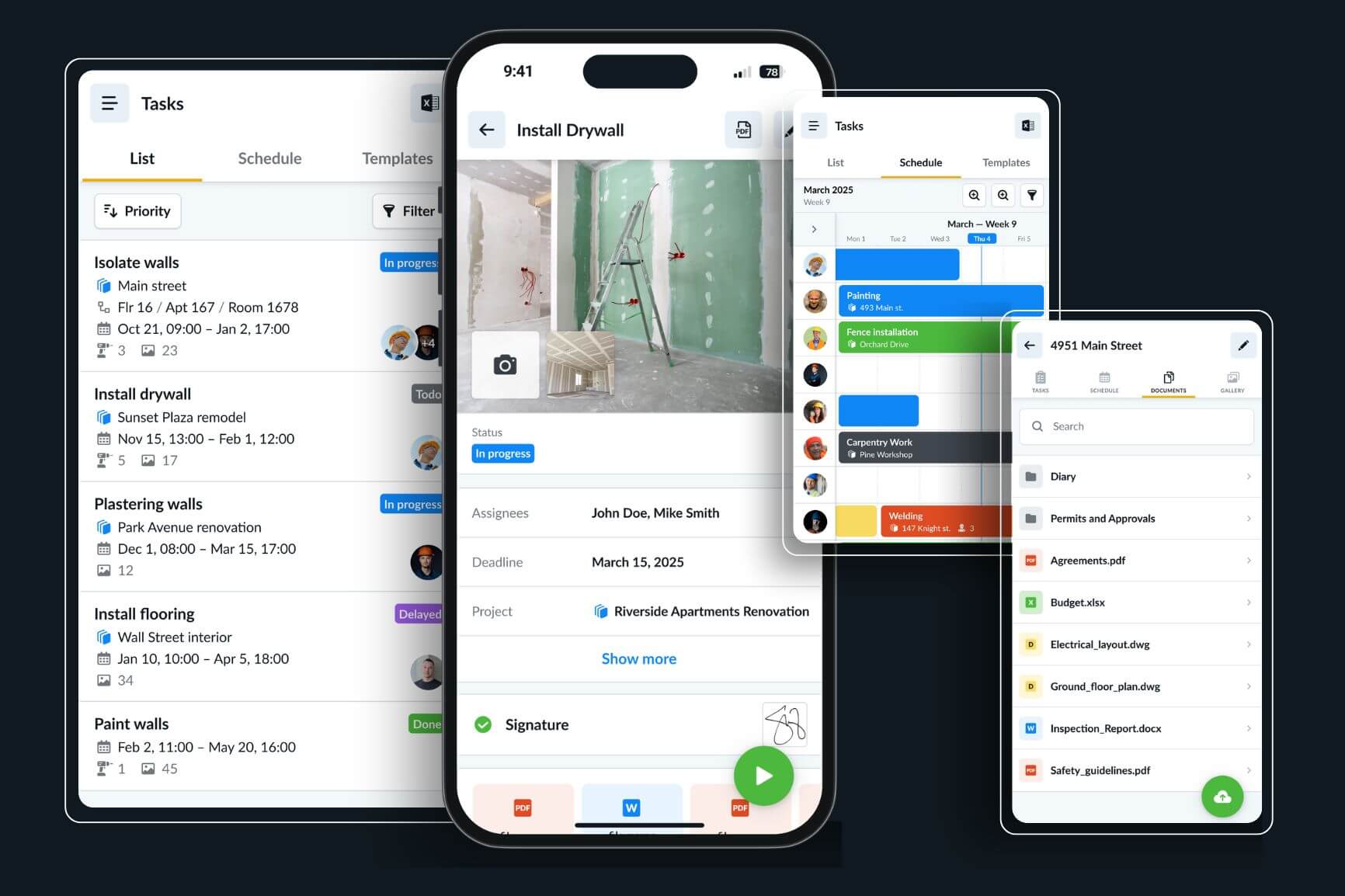
A manual report is usually prepared in Word, Excel, or PDF. The subcontractor gathers information from timesheets, site diaries, task lists, photos, delivery records, and supervisors before compiling the weekly update.
A digital report contains the same six sections, but the information is captured as work happens. Tasks, hours, materials, equipment, comments, photos, and completion statuses can be pulled directly into the report instead of being reconstructed at the end of the week.
This makes digital reporting faster and generally more reliable, although the responsible manager should still review the report and explain any delays, risks, or unusual results.
With Remato, this process becomes seamless and easy. When subcontractors already use the platform to track tasks, working hours, materials, tools, site photos, and work status, the weekly report can be generated from the same live project data. The main contractor gets a clear overview without asking every subcontractor to enter the same information again.
This isn’t limited to one trade – HVAC, plumbing, electrical, framing, and most other subcontractors on a site end up needing to report the same six things every week, regardless of what they’re installing.
Progress reporting is directly linked to cash flow and construction plan management.
Payment: Most contracts tie payment applications to a Schedule of Values or agreed scope breakdown. Payment delays are one of the most common problems in construction and accurate weekly reporting is one of the few tools that helps resolve disputes over what was actually completed.. Your weekly progress report is often the evidence the main contractor uses to verify what you’re claiming in your payment application. If your reported percentage complete doesn’t match your invoice, expect delays or disputes while it gets reconciled.
Scheduling: Main contractors use subcontractor reports to update the master programme. If your report shows a delay, they can reallocate resources, notify affected trades, or adjust the critical path before the problem compounds. If delays only surface informally — a phone call, a passing comment on site — they lose that lead time.
Claims and disputes: If a delay or defect ever escalates into a formal claim, your weekly reports (particularly the dated photos and documented issues) become part of the record both sides rely on. Consistent, accurate reporting is one of the best forms of protection you have as a subcontractor.
A construction progress report is most commonly confused with these:
| Document | Main purpose | Difference from a progress report |
|---|---|---|
| Site diary / daily report | Records daily events, labour, weather, deliveries and incidents | More detailed and daily; a progress report usually summarizes a week or month |
| Progress claim / payment application | Requests payment for completed work | Focuses on money and measured quantities, not the full project situation |
| Plan update / schedule update | Shows planned and actual dates | Focuses mainly on timing and critical-path effects |
| Look-ahead programme | Lists work planned for the next few weeks | Forward-looking; a progress report also explains completed work and current issues |
| Site inspection report | Records observations from an inspection | Focuses on quality, compliance or defects rather than overall progress |
| Snagging / defect report | Lists defective or unfinished items | Tracks problems to fix, not total project advancement |
| Building survey | Assesses the condition of an existing building | Concerns condition and defects, not construction performance |
| Construction survey | Measures positions, levels and dimensions | Technical setting-out or measurement work, not management reporting |
| As-built survey/report | Records what was actually installed | Usually produced after or during completion to document final locations |
| Meeting minutes | Records discussions, decisions and actions | May contain progress information but is not a complete progress assessment |
| Delay notice | Formally notifies a contractual delay | A legal or contractual notice; mentioning delay in a progress report may not be sufficient |
| Variation report/request | Records changed or additional work | Deals specifically with scope and cost changes |
The three most common mix-ups are usually:
A progress report is broader: it normally combines completed work, planned work, percentage progress, labour, materials, delays, risks, photographs and required actions.
A weekly progress report doesn’t need to be complicated, but it does need to be consistent, specific, and honest — especially about problems. Covering the same six sections every week (project details, work completed, work planned, resources on site, issues and risks, and photo documentation) gives your main contractor exactly what they need to keep the programme moving and your payments on track.
Whether you build it manually in a template or capture it as you go with a digital tool like Remato, the goal is the same: turn a week of site activity into a record that’s fast to read, hard to dispute, and directly useful to the people relying on it.
There are two practical options: use a standard template in Word, Excel, or PDF, or use a digital construction-management platform such as Remato.
A manual template is suitable for smaller projects, but someone must collect and verify the information each week. With a digital platform, data recorded through daily tasks, working hours, materials, photos, and status updates can be used to generate the report with much less repeated administration.
EU construction-site legislation includes requirements relating to matters such as health and safety, coordination, and site responsibilities, but it does not establish one universal weekly progress-report format for subcontractors.
Subcontractors should therefore check the subcontract rather than assume that reporting is automatically required by law. National requirements may also differ, so project-specific legal advice may be needed where compliance is uncertain.
No. A building survey and a construction progress report serve different purposes.
They may be required before renovation, demolition, extension work, tender pricing, property purchase, defect investigation, or handover.
Building surveys are commonly used by:
– Building surveyors
– Architects
– Structural and civil engineers
– Main contractors
– Specialist subcontractors
– Property developers
– Property owners
– Facility and asset managers
No. These records are related, but they are not interchangeable.
A site diary records daily events such as attendance, weather, deliveries, instructions, incidents, and work taking place.
A work report or job sheet usually records a particular activity, including working hours, materials, notes, and signatures.
A weekly progress report combines and summarises information from across the reporting period.
Site diaries, work reports, timesheets, task updates, and photographs can all provide source data for the weekly progress report. In a digital system such as Remato, that information can be collected during normal site work and then presented as one structured weekly update.