{{ post.date }}
{{ post.readTime }}

Construction payroll is rarely just a matter of multiplying hours by an hourly rate.
A single project may involve a client, a main contractor, several layers of subcontractors, labour agencies, local employees, posted workers and self-employed tradespeople. Those workers may move between sites, work irregular schedules, receive different types of allowances and be covered by construction-sector collective agreements that provide more generous conditions than general employment law.
That combination makes construction one of the most difficult industries in which to manage working time and payroll correctly.
The central compliance question is not simply:
How many hours did this person work?
It is:
Who employed the person, what was their legal status, where did they work, which law and collective agreement applied, how were their hours established, what should they have been paid, and can every amount paid or deducted be proved?
A reliable construction compliance system should create a continuous evidence trail:
worker status → employment terms → site and time records → wage classification → payroll calculation → payslip → payment → tax and social-security reporting
This guide explains the main framework employers, main contractors and subcontractors need to understand when managing working hours and payroll in European construction.
It focuses on EU and EEA principles and the operational systems that support compliance. Exact employment, payroll, tax, social-security, collective-agreement, posting and record-retention rules still need to be checked in the country where the work is carried out.
The single most important idea in this whole subject: the European Union does not directly regulate your payroll. The EU issues directives, which set a floor – a minimum standard. Each member state then writes its own binding national law to hit that floor, and is free to go stricter. So when you ask “what’s the legal requirement?”, the honest answer is almost always: it’s your national law, which must meet or exceed the EU minimum.
Three practical consequences follow:
The floor is common, the detail is local. Every EU country guarantees the same core rights – a capped working week, daily and weekly rest, paid leave, a record of hours, a pay floor. But the numbers behind those rights (the minimum wage, how many years you keep records, how deep subcontractor liability runs) are set nationally and differ sharply. Two countries bound by the same directive can have minimum wages that differ by a factor of three.
Stricter-than-the-floor is normal in construction. Countries routinely add construction-specific rules on top: real-time electronic time-recording, whole-chain wage liability, mandatory sector funds. The EU minimum is rarely the ceiling in this industry.
The EEA is in the frame too. Norway, Iceland and Liechtenstein are not EU members but belong to the European Economic Area, and through the EEA agreement they adopt most of the same labour directives. A Norwegian project carries obligations that look very similar to an EU one.
The one skill this section teaches is a single question you should be able to answer for any worker on any site: given this person, on this site, in this country- whose rules apply? The answer depends on where the work is physically performed (the host country’s rules generally govern conditions on site), whether the worker is “posted” from another country (a cross-border layer – Section 6), and which collective agreement covers the trade at that location (Section 7). Resolve that question first. Everything else is downstream of it.
The EU Working Time Directive (2003/88/EC) sets the baseline national law must deliver. The headline limits:
| Requirement | EU baseline |
|---|---|
| Maximum working week | 48 hours on average, including overtime, over a reference period (commonly up to 4 months, longer where a collective agreement allows) |
| Daily rest | At least 11 consecutive hours in every 24 hours |
| Weekly rest | At least 24 uninterrupted hours, on top of the daily 11 (≈35 hours) per 7-day period |
| Breaks | Required once the working day exceeds six hours; duration set nationally or by agreement |
| Paid annual leave | At least four weeks per year |
| Night work | Normally no more than an average of eight hours per 24-hour period, with health protections |
Those are the easy parts to state. The construction difficulty is in the edge cases.
Reference periods and seasonal averaging. Construction is seasonal and weather-dependent. The 48-hour cap is an average, so long summer weeks can be balanced against short winter ones – but only within the reference period your national law or collective agreement allows, and only if you actually track the running average. Averaging is legitimate; failing to monitor the average is a breach waiting to be found.
Overtime. The directive caps total hours but leaves overtime premiums to national law and collective agreements. The applicable construction agreement usually sets the overtime multiplier and when it kicks in (daily threshold, weekly threshold, weekend, night). This is where a lot of underpayment claims start, because it’s easy to get the trigger point or the rate wrong.
Travel time between sites. A grey area. Time spent travelling between work sites during the day is generally working time. Ordinary commuting from home to a fixed workplace generally is not – but for mobile workers with no fixed place of work, case law has treated the first and last journeys of the day as working time. If your crews rove between sites, this can move someone over the 48-hour line.
On-call and standby. Whether on-call time counts depends on how constrained the worker is. Must remain on site or respond within minutes? Usually working time. Genuinely free until called? Usually not. The tighter the leash, the more likely it counts.
Long shifts and away-work. Rotational and away-from-home patterns must still respect daily and weekly rest, or fall within a properly agreed derogation. “The lads wanted to work through so they could go home early” is not a defence if it breaches mandatory rest.
The theme across all of these: the limits are not optional, workers generally cannot validly waive their core rest rights, and the burden of showing you stayed within them falls on you – which is exactly why the next section matters so much.
Do you really need to track hours, and prove them? Across the entire EU and EEA, yes – without exception.
The turning point was a 2019 ruling of the Court of Justice of the EU, CCOO v Deutsche Bank (C-55/18). A Spanish union argued that without a record of daily hours, there was no way to know whether working-time and overtime limits were being respected. The Court agreed: member states must require employers to set up an objective, reliable and accessible system that records the daily working time of every worker. This protection cannot be traded off against cost – you must have the system regardless of the expense.
Two consequences now sit behind every national regime:
The burden of proof is on the employer. If a worker claims unpaid overtime or a rest breach and you have no reliable record, the absence of records counts against you. “We didn’t track it” is not neutral; it is close to conceding the point.
Daily recording is the standard – not weekly totals or exception-only logs. You need start times, end times, breaks and total hours per worker per day, in a form an inspector or court can read.
Per worker, per day, at minimum:
It must be reliable (not casually editable after the fact), accessible (retrievable when an inspector or worker asks), and retained for the period your national law requires. Records should be approved regularly by both worker and supervisor, and later changes should stay visible rather than overwrite the original. A site-access log alone may be insufficient – presence on site is not always the same as paid working time. Ideally the system also flags when someone nears the 48-hour average or breaches a rest rule, so problems surface before they become violations.
Several countries have gone well beyond a paper timesheet:
Other countries require a robust record without mandating a specific platform – but the direction of travel is clearly toward digital, tamper-resistant, increasingly real-time systems.
The hardest practical challenge is clocking a worker who touches several sites in one day. A fixed turnstile at one gate does not capture that. Workable answers: mobile/geolocated clock-in apps, per-site sign-in tied to a central record, or badge systems that consolidate across sites. The essential point is that the worker’s total daily hours are captured accurately no matter how many locations were involved. Build the system around the person’s day, not around any single gate.
This is where purpose-built construction software can remove a lot of the manual work between the site and payroll.
Remato’s construction time tracking allows workers to record their working time from the field, while managers can connect those hours to the relevant project or site and review timesheets centrally. GPS-based attendance verification can also provide additional context around where working time was recorded.
For contractors managing several sites, this creates a much cleaner time tracking for payroll workflow:
worker clocks time → hours are linked to the site/project → supervisor reviews them → approved hours are available for payroll
That connection between payroll and time tracking matters. Payroll should not have to reconstruct a worker’s month from paper timesheets, WhatsApp messages, gate-access logs and spreadsheets. The closer the approved payroll input is to the original site record, the easier it is to identify missing hours, questionable entries and payroll discrepancies before wages are processed.
Remato’s guide, Construction Time Tracking From Jobsite to Office: How to Save Hours Every Week with Better Systems, explores this workflow in more detail, including how field workers can log time and breaks digitally and how centralised records reduce the administrative work involved in compiling construction timesheets.
In a wage or overtime dispute, missing records shift the argument to the worker’s account of their hours. In an inspection, absent or unreliable records are themselves a breach, drawing fines independently of anything else found and in several countries those amounts scale with the number of workers affected. Poor records also undermine every other defence you might run, including the due-diligence defence against chain liability (Section 6). Good time records are the foundation the rest of your compliance stands on.
Getting hours right is half the job; paying correctly is the other half. Several obligations overlap here.
Statutory minimum wage vs sector-agreement minimums. Most EU countries have a statutory minimum wage, but in construction that is frequently not the binding floor. Where a collective agreement covers the trade – especially where it has been made generally binding the agreement’s (usually higher) rate applies. You must pay the higher of the statutory minimum or the agreement rate. A handful of countries – Finland, Sweden, Denmark, Austria, Italy, and non-EU Norway – have no statutory minimum at all; there, the construction collective agreement is the pay floor, full stop.
What legally counts toward the minimum and what doesn’t. This is where underpayment hides. The minimum generally must be met by basic pay for hours worked. Amounts that reimburse the worker for costs of the posting or the job typically cannot be counted toward the minimum – travel allowances, tool allowances, and money deducted or charged for accommodation are common examples. Treating a travel allowance as if it were wages, or docking accommodation costs so effective pay dips below the floor, is a classic route to an underpayment finding.
Overtime premiums, holiday pay and allowances. Overtime must be paid at the premium set by law or the applicable agreement. Paid holiday must be genuinely paid (in some countries via a sector fund – Section 7). Allowances required by the agreement (site, travel-time, meal) are contractual obligations, not optional extras.
Payslips and written terms. The Transparent and Predictable Working Conditions Directive (EU 2019/1152) requires workers to receive written information about their essential terms, including pay, and national law requires itemised payslips. The payslip is a compliance document that must show how pay was built up – not a courtesy.
The incoming Pay Transparency Directive (EU 2023/970). Binding from June 2026, this adds obligations around pay-range disclosure in recruitment, a ban on asking candidates their salary history, employees’ right to information about pay criteria, and gender pay-gap reporting for larger employers. It shifts the burden of proof to the employer in pay-discrimination claims where transparency obligations were not met. Even a mid-sized contractor should be mapping its pay structures against it now.
The best way to make all of the above concrete is to run one payroll from hours to net. The numbers below are illustrative – exact rates, thresholds and the order of operations differ by country, so treat this as a model of the method, not a lookup table.
Scenario. A construction labourer paid an hourly rate. This week they work five days:
Step 1: Verify hours against the limits. 45 hours in one week is fine against the 48-hour cap for that week, but check the running average across the reference period, and confirm daily rest (11h) was respected between the two long days. Record all of it; the timesheet is the evidence.
Step 2: Build gross pay.
| Component | Calculation | Amount |
|---|---|---|
| Standard hours | 40 × €18.00 | €720.00 |
| Overtime hours | 5 × (€18.00 × 1.5) = 5 × €27.00 | €135.00 |
| Gross pay for hours worked | €855.00 | |
| Site/travel allowance | €40.00 | |
| Total gross this week | €895.00 |
Of that, €855.00 is the wage that must clear the minimum-wage and agreement-rate test; the €40 allowance does not count toward that test.
Step 3: Check the floor. Effective wage rate = €855.00 ÷ 45 hours = €19.00/hour. Confirm this is at or above both the statutory minimum and the applicable construction agreement rate for this worker’s classification. If the agreement rate for their grade were, say, €19.50, you would be underpaying and would need to top up – the allowance cannot rescue you.
Step 4: Add holiday pay / sector-fund contributions. Depending on the country, holiday pay is either accrued and paid by you or routed through a sector fund. In the Netherlands, an 8% holiday allowance accrues on top of gross. In Germany, holiday pay runs through SOKA-BAU at roughly 15–16% of gross wages (Section 7) – an employer cost you must budget and remit, even for posted workers.
Step 5: Apply employer social security and levies. On top of gross, the employer owes social-security and related contributions. These vary widely: representative construction-sector employer loading is often around 18–32% of gross (e.g. Netherlands ~18–22%, Spain ~30%). So the true cost to the business of this week is not €895 – it is roughly gross + holiday accrual + employer contributions, which can push the fully-loaded cost 25–45% above the headline gross. This “burden rate” is what should feed your project bids.
Step 6: Deduct employee contributions and tax to reach net. From the worker’s gross, deduct employee social-security contributions and income-tax withholding per national rules to reach net take-home. In 14-payment countries like Spain and Greece, the annual figure is spread across 14 instalments, which changes the monthly maths.
Step 7: Produce the payslip. It must itemise: standard hours and rate, overtime hours and rate, allowances, gross, each deduction, employer contributions where shown, and net.
For hourly construction workers, the practical process is to start with the approved daily time records rather than the contracted schedule.
First, total the worker’s ordinary hours for the payroll period. Then separate any hours that require different treatment, such as overtime, night work, weekends, public holidays, paid travel or other premium categories. Apply the correct rate or multiplier to each category and add any taxable allowances or other remuneration.
In simple terms:
approved hours × applicable rates + premiums + allowances = gross payroll
From there, apply the required tax, social-security contributions and other lawful deductions to arrive at net pay.
The important part is that reporting hours worked and calculating payroll should use the same underlying records. If a supervisor approves 45 hours but payroll processes 40, the discrepancy should be identified before payment rather than discovered later during an employee complaint or inspection.
The figures should always reconcile:
recorded hours × applicable wage rates + allowances − lawful deductions = net amount actually paid.
The lesson from running it end to end: the headline hourly rate is a small part of the picture. Overtime triggers, what counts toward the floor, holiday/fund contributions, and the employer burden rate are where compliance is won or lost – and where bids are priced correctly or ruinously.
This is the section that keeps main contractors awake, and rightly so. In construction, the law lets a worker who wasn’t paid reach up the contracting chain.
The EU baseline. Under the Enforcement Directive (2014/67/EU, Article 12), for construction activities every member state must ensure that a posted worker who isn’t paid the proper wage by their direct employer can hold the contractor one step up liable for the shortfall, in addition to or instead of the employer. That is the mandatory minimum. Many countries go further, and may make a principal liable for a subcontractor’s unpaid minimum wages, holiday-fund and social-security contributions, wage taxes, and penalties connected with undeclared labour.
How deep it runs varies by country:
| Country | Depth | Instrument |
|---|---|---|
| Germany | Whole chain – Bürgenhaftung (guarantor liability); indemnity clauses cannot displace it | AEntG |
| France | Whole subcontracting chain | National law |
| Austria | Extends to the client, not only the direct employer | National law |
| Italy | Joint liability of the principal for wage and social-security obligations; not excludable by contract | National law |
| Netherlands | Deep chain liability | WKA (tax/contributions) + WAS (wages) |
| Spain | Joint-and-several, with limits on tiers of subcontracting | Art. 42 Workers’ Statute + Ley 32/2006 |
| Finland | Due-diligence duties on the engaging party | Contractor’s Obligations Act (tilaajavastuulaki) |
| Norway | Joint liability for wages under generally-binding CBAs | Solidaransvar |
The due-diligence defence. In several regimes, a contractor who exercised genuine due diligence over its subcontractors can defend or limit its liability. This is why vetting is not box-ticking – it is your actual protection. But note the German lesson: in some countries the statutory liability is close to strict, and a contract clause saying “the sub indemnifies us” will not save you. Know which type of regime you’re in.
Contract clauses – what works and what doesn’t. Indemnity and flow-down clauses are worth having (they let you recover from the sub, if the sub is still solvent), but they do not extinguish your liability to the worker or the state where the law makes it non-excludable. Clauses that genuinely help are ones that give you control and evidence: rights to see the sub’s payroll and time records, to require proof of wage payment and social-security remittance before you release payment, to audit, and to withhold or terminate on non-compliance.
A practical vetting process.
Before engaging a subcontractor:
During the project:
Respect data-protection rules throughout: request only what is necessary, control access, and don’t retain excessive personal payroll data. Documented, ongoing due diligence is both good operational practice and, where available, your legal shield.
In large parts of Europe the statute is only half the story – the construction collective bargaining agreement (CBA) sets the pay rates, allowances, overtime rules and conditions that actually bind you.
CBAs set the real floor. Where a construction CBA applies, it typically sets minimum pay by worker classification (labourer, skilled trade, foreman), plus site allowances, travel-time rules, overtime multipliers and often supplementary benefits. You apply the higher of statute or agreement – the statutory minimum wage is never a ceiling you can use to undercut a CBA rate.
Generally-binding agreements. In many countries a construction CBA can be declared generally binding (erga omnes), meaning it applies to every employer in the trade in that country – including foreign firms posting workers in – whether or not they signed it or belong to the signatory association. Finland, Norway (allmenngjøring), the Netherlands, France and others use this mechanism. If you operate in such a country, “we’re not a member of that association” is irrelevant: the agreement still binds you.
Sector funds – the SOKA-BAU example. Some countries route construction workers’ holiday pay, and sometimes pensions and training levies, through dedicated industry funds rather than leaving them with the individual employer. The classic case is Germany’s SOKA-BAU. Because construction workers change sites and employers frequently and can’t work through winter, the fund pools holiday entitlements so they aren’t lost. Every employer doing construction work in Germany – including foreign companies posting workers in – must register and contribute, at roughly 15–16% of gross wages (holiday and vocational-training funds; the rate differs slightly between western and eastern Germany). It remits monthly and reimburses holiday pay to the worker. Similar paritarian funds exist elsewhere: Austria’s BUAK, France’s CIBTP, Italy’s Casse Edili, and Belgian and Danish equivalents, with mutual-recognition arrangements that may exempt you if you already contribute to a comparable fund at home. Surprise SOKA-BAU bills are a frequent, expensive shock for firms posting workers who didn’t budget for them.
How to read and apply a CBA. Identify the correct agreement for the trade and location; find the worker’s classification and its rate; note the allowances and overtime rules; check whether it’s generally binding (so it applies regardless of membership); and confirm whether a sector fund handles holiday/pension so you contribute correctly. Then always pay the higher of that rate or the statutory minimum. Reading the agreement wrong – wrong classification, missed allowance, overlooked fund – is a common and costly error.
Everything above becomes real only if you operationalise it.
Documents to keep – and for how long. Build a document set covering, at minimum: employment contracts and written statements of terms; daily time records; payslips and payroll registers; proof of wage payment and social-security remittance; A1 certificates and posting notifications for cross-border workers; subcontractor due-diligence records; and CBA/sector-fund correspondence. Retention periods are set nationally and differ – Spain requires time records kept four years; Poland’s personnel/payroll retention runs to about a decade; working-time records elsewhere may be a shorter two–three years. When in doubt, keep longer, and confirm the exact period for each country.
A compliance calendar. Map the recurring deadlines: payroll runs; social-security and tax filings; sector-fund monthly statements and payments (SOKA-BAU’s monthly deadlines); posting notifications before mobilising cross-border crews; minimum-wage uprating dates (most countries each January, the Netherlands also in July, Greece around April); and periodic subcontractor re-checks. Missed deadlines are avoidable breaches.
Audit-readiness. Assume an inspection could come tomorrow. Can you, on request, produce for any named worker their contract, their daily hours for the period, their payslips, and proof they were paid correctly – quickly and readably? If retrieving that takes days of digging, you are not audit-ready. Run occasional internal dry-runs.
Tools and software. The multi-site, multi-jurisdiction reality defeats spreadsheets past a certain scale. Look for time-recording that is mobile, geolocated and tamper-resistant; payroll that handles overtime rules, allowances, sector-fund contributions and multi-country rates; and document management that ties records to worker and site. The goal is a system where a compliant record is produced automatically as a by-product of normal work, not assembled by hand afterward.
Who owns what. Assign responsibility explicitly:
Unassigned responsibility is unmet responsibility.
A digital time record becomes more valuable when the office can turn the information into a usable timesheet or report without entering the same hours again.
Remato combines construction time tracking with project and task information, allowing businesses to see who worked, where they worked and how long the work took. Its timesheet and reporting functionality can then be used to prepare working-time information for payroll and project-cost review.
This is particularly useful when you need to generate payroll report data across multiple workers or sites. Instead of asking supervisors to re-enter weekly totals, the business can review the underlying time records first and then use the approved information for payroll processing.
Whether your internal terminology is create a payroll report, make payroll report, export timesheets or prepare payroll hours, the control principle should remain the same:
The report should be generated from approved working-time data—not created separately from memory or manually reconstructed at payroll cut-off.
This also improves the audit trail because the company can trace a payroll figure backwards from the report to the worker, project, dates and original time entries.
For a practical example of why this matters across several projects, Remato’s article How to Manage Multiple Construction Sites Without Being Everywhere explains how linking time to sites and tasks gives managers daily visibility into who was working where and for how long.
For sites with unreliable connectivity, its guide How Reliable Offline Time Tracking Software Helps Construction Crews Stay On Schedule is also relevant: workers can record their start and finish even without an active internet connection, with the information synchronised when connectivity returns.
One-page references for the countries covered here. Verify before relying – figures move and the decisive detail is always the current national law. Minimum wages below are the July 2026 position.
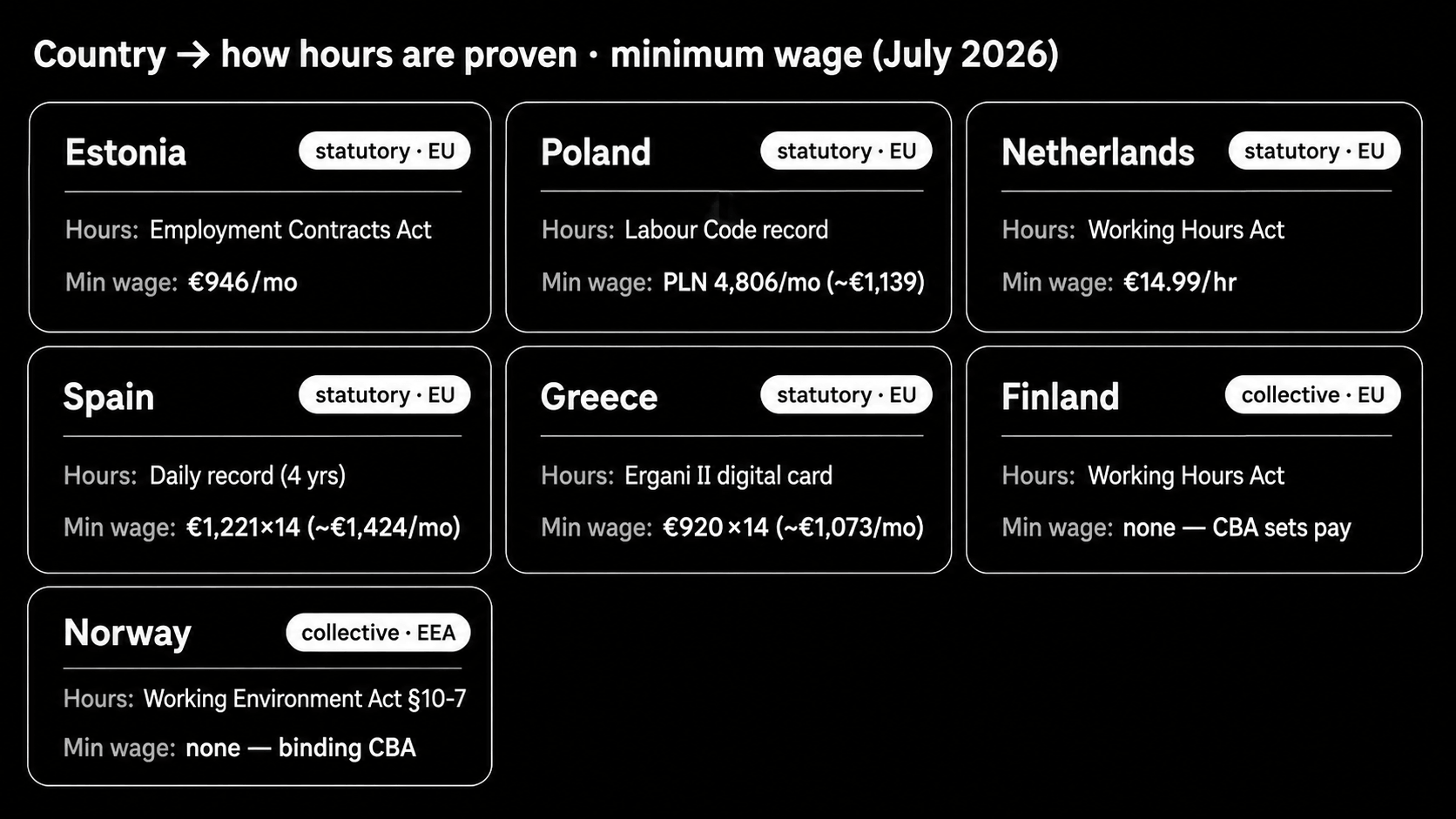
| Country | Statutory minimum | Notes |
|---|---|---|
| Estonia | ~€946 / month | Agreed by social partners |
| Poland | PLN 4,806 / month (~€1,139) | Fixed for the calendar year, no mid-year change |
| Netherlands | €14.99 / hour (from 1 July) | Hourly-only since 2024; ~€2,600/mo at 40h; re-indexed Jan & Jul |
| Spain | €1,221 / month × 14 payments (~€1,424/mo, 12-pay equiv.) | Royal Decree; Art. 27 Workers’ Statute |
| Greece | €920 / month × 14 payments (~€1,073/mo, 12-pay equiv.) | Raised 1 April 2026; targets ~€950 by 2027 |
| Finland | None | Construction CBA sets pay |
| Norway | None | EEA; construction CBA, generally binding (allmenngjøring) |
| Country | Regime | Character |
|---|---|---|
| Estonia | Record under the Employment Contracts Act | Standard record; overtime logged |
| Poland | Ewidencja czasu pracy (Labour Code) | Per-employee working-time record |
| Netherlands | Working Hours Act (Arbeidstijdenwet) | Sound record of hours & rest for the Inspectorate |
| Spain | Registro de jornada | Mandatory daily record; kept 4 years; open to inspectors & unions |
| Greece | Ergani II digital work card | Real-time electronic clock in/out to the state platform |
| Finland | Työaikakirjanpito (Working Hours Act) | Per-employee working-hours record |
| Norway | Working Environment Act §10-7 | Overview of hours available to the Labour Inspection |
| Country | Depth | Instrument |
|---|---|---|
| Estonia | Around the EU minimum (one step up for posted workers) | PWD transposition |
| Poland | Investor / general-contractor liability for subcontractor remuneration | Civil Code + PWD transposition |
| Netherlands | Deep chain liability | WKA (tax/contributions) + WAS (wages) |
| Spain | Joint-and-several, with tier limits | Art. 42 Workers’ Statute + Ley 32/2006 |
| Greece | Joint liability for sub’s wage/contribution obligations | Civil/labour law + PWD transposition |
| Finland | Due-diligence duties on the engaging party | Contractor’s Obligations Act (tilaajavastuulaki) |
| Norway | Joint liability for wages under binding CBAs | Solidaransvar |
| Country | Record retention (typical) | Posting / notification essentials |
|---|---|---|
| Estonia | ~3–7 yrs (payroll longer) | A1 + posting notification to the labour authority |
| Poland | Personnel/payroll up to ~10 yrs | A1 + notification to the State Labour Inspectorate (PIP) |
| Netherlands | Commonly ~5–7 yrs (payroll/tax) | A1 + online posting notification (meldloket) |
| Spain | Time records 4 yrs; payroll longer | A1 + notification to the regional labour authority |
| Greece | Aligned to Ergani/payroll rules | A1 + E-declarations via Ergani |
| Finland | Working-hours record ~2 yrs; payroll longer | A1 + notification to occupational-safety authority; tilaajavastuu checks |
| Norway | Commonly several yrs | A1/posting registration (Altinn); RF-1199 assignment reporting |
(Retention and notification specifics change and vary by document type – always confirm the current national requirement for each record.)
If you take only a few things from this guide, take these.
The rules come in layers, and you must know which layer governs each worker: the EU directive floor, the national law that implements and often exceeds it, and the construction collective agreement – frequently generally binding – that sets the real pay rates and conditions. Resolving “whose rules apply to this worker, on this site, in this country?” is the first move every time.
You must record hours, and be able to prove them. Since the 2019 CCOO ruling this is settled across the EU and EEA: daily, reliable, retrievable records for every worker, with the burden of proof on you. In Greece and Spain the state expects real-time or daily digital records; everywhere, the absence of records counts against you.
Pay is more than an hourly rate. The overtime trigger, what counts toward the minimum, holiday pay and sector-fund contributions, and the employer burden rate are where compliance – and correct bidding – actually live.
In construction, you are exposed to the failures of firms below you in the chain. Joint-and-several liability for a subcontractor’s unpaid wages and contributions is real, often non-excludable by contract, and your protection is documented, ongoing due diligence – not a clause.
Build the system that produces compliant records as a by-product of normal work, keep the country cheat sheets close for the places you operate, and confirm the specifics locally before you rely on them. Do that, and hours-and-payroll compliance stops being the thing that keeps you awake and becomes just another part of running the job well.
Every link points to an official EU institution or a national government/labour authority. If a deep link has moved, start from the institution’s home domain.
European directives (full text on EUR-Lex)
EU-level official portals
National authorities and rules