{{ post.date }}
{{ post.readTime }}
Construction projects rarely fail because teams lack skill. They fail because time is not controlled.
The numbers back this up. The EU construction sector is made up of companies where 99% are small or medium-sized businesses, yet the European Commission’s 2025 Payment Observatory report confirms that schedule disruptions remain their biggest operational challenge, with delays estimated to cost EU small businesses over €100 billion in locked cash flow every year. Not because of missing expertise, but because of missing coordination.
And it is getting harder. The European Construction Observatory reported in December 2025 that between 25% and 30% of EU construction firms say labour shortages are actively limiting their output. Furthermore, Eurostat data shows that EU construction labour costs rose by 4.0% year-over-year in Q4 2025 with the non-wage component surging 5.8%, the highest increase of any sector across the entire EU. In this environment, every unplanned idle day is expensive.
On a modern jobsite, dozens of activities happen at once. Crews move between locations, materials arrive from different suppliers, inspections interrupt progress, and conditions change daily. Without structured construction scheduling, even experienced teams lose coordination.
At its core, scheduling is what turns a plan into execution. It defines what needs to happen, when it should happen, and in what sequence. Effective work planning goes beyond listing tasks. It structures the entire workflow of a construction project. If you need a ready-made template for this, download our construction task list.
However, modern projects require more than static timelines. An effective schedule must be continuously updated, aligned with real site conditions, and flexible enough to adapt to change.
In this guide, I will walk you through what construction scheduling is, how it works in real projects, and how to build a schedule that keeps your projects on track and profitable. For day-to-day field coordination, see how to keep a project on track without chasing crews all day.
At a practical level, construction scheduling is the process of organizing all project activities into a clear, time-based sequence that teams can follow during execution.
It answers three fundamental questions:
This is what makes it the bridge between planning and real work on-site.
It is important to distinguish between the process and the output.
Construction scheduling refers to the ongoing process of planning, sequencing, coordinating, and updating project activities.
A construction schedule, on the other hand, is the actual document or system that represents that plan. It can take different forms, such as a Gantt chart, timeline, or digital dashboard, but its purpose is always the same: to provide a shared reference point for everyone involved in the project.
The schedule is not something you create once and forget. Research by the Lean Construction Institute shows that initial project schedules frequently fail to accurately forecast total cost, final duration, and task count. In other words, the schedule has to live and breathe with the project, and that is exactly what makes it a continuous process rather than a one-time task.
Effective planning goes beyond listing tasks. It structures the entire workflow of a project.
A well-built schedule typically includes:
All of these elements work together to make the schedule actionable rather than theoretical.
The scheduling process is not handled by one person alone. It is a collaborative process that involves multiple roles.
Depending on project size, the following stakeholders typically contribute:
For example, a subcontractor laying electrical wiring will know far better than any office-based planner how long that work takes. When they are not involved in building the schedule, the estimates are often wrong, and that is one of the most common and most fixable causes of project delays.
One of the biggest misconceptions is that the work ends once the schedule is created. In reality, the opposite is true.
As soon as construction begins, the schedule starts to drift from the original plan. Weather, material delays, design changes, and workforce availability all introduce variability.
This means the process must include:
For example, if a delivery is delayed, teams may need to resequence tasks or reallocate crews to avoid downtime.
This is why modern scheduling tools are increasingly used to support real-time updates and coordination across teams.
Many teams still rely on spreadsheets or static timelines. While these can work for small projects, they struggle to handle complexity.
As projects grow, effective planning requires:
Secondly, using a structured construction schedule template early in the process can help standardise task breakdown and dependencies, reducing errors before execution begins.
However, long-term success depends on moving beyond static tools and treating scheduling as a living system.
Every construction project depends on timing, and scheduling is what connects all moving parts.
Without it:
I will be direct with you: poor scheduling is one of the most expensive problems in construction. According to KPMG, only 25% of construction projects are completed within 10% of their original deadlines. For small and medium firms across Europe, a single badly managed project can put the whole business under pressure.
Furthermore, strong construction management scheduling ensures that:
Delays in construction rarely come from a single mistake. They come from accumulated misalignment. A well-maintained schedule prevents that accumulation.
Not all projects use the same structure when it comes to scheduling. The type of schedule and the method behind it depend on project size, complexity, and how many moving parts need coordination.
Understanding different types of schedules and the methods used to build them helps you choose the right level of control and the right tools for execution.
In practice, planning operates on multiple layers at the same time.
Beyond structure, construction scheduling also depends on how information is visualized.
Different projects require different techniques. In many cases, teams combine multiple methods rather than relying on just one.
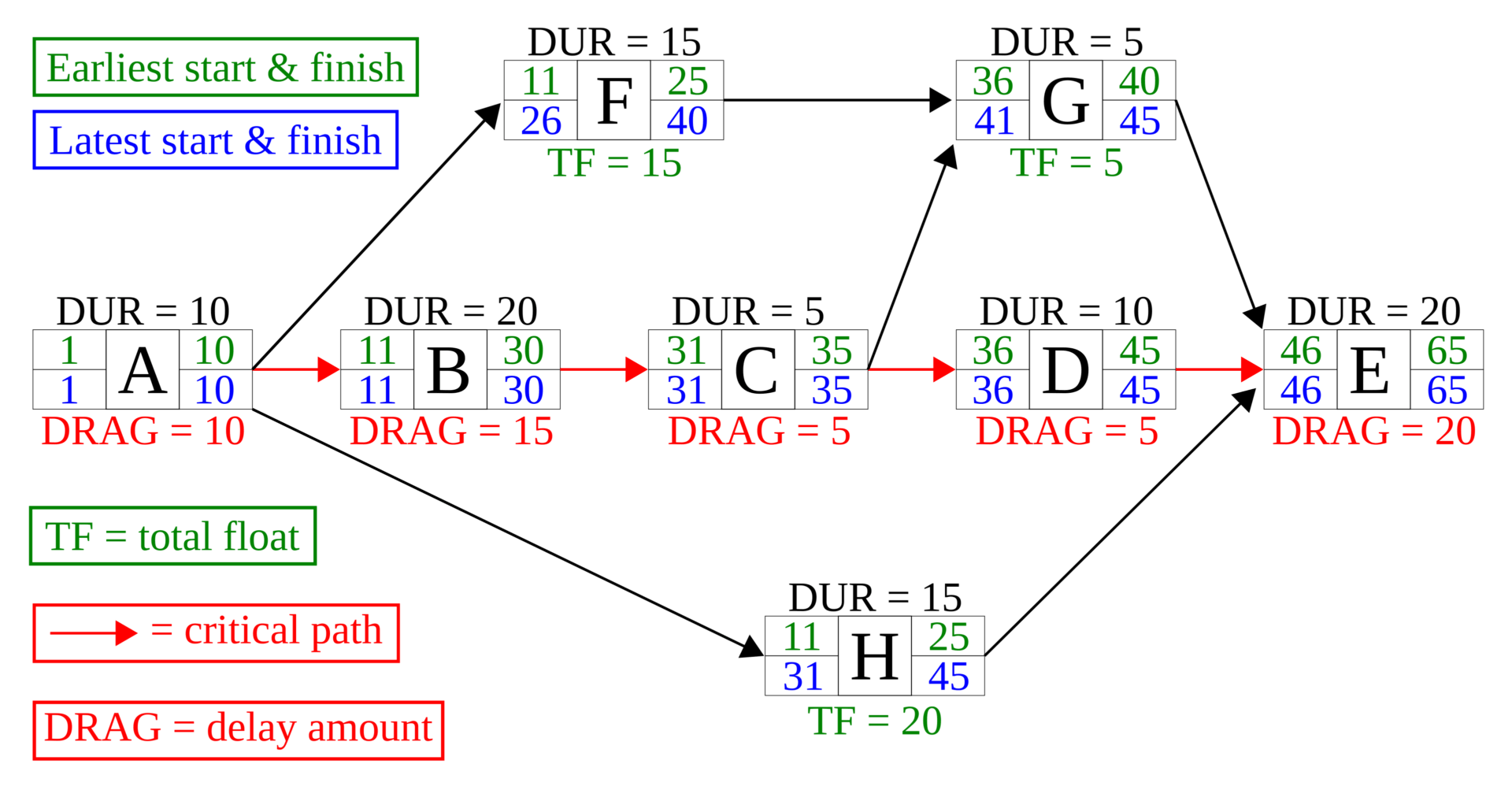
Critical Path Method (CPM)
CPM was developed in the late 1950s by Morgan R. Walker from DuPont and James E. Kelley Jr. It was first applied on a large-scale construction project in 1958 and gained global recognition in 1966 when it was used to plan the construction of the World Trade Center Twin Towers in New York City. It is one of the most widely used methods in construction management, and it identifies the sequence of tasks that directly affect project duration.
Program Evaluation and Review Technique (PERT)
A probabilistic method that accounts for uncertainty by using three time estimates.
Line of Balance (LOB)
Designed for repetitive work such as high-rise buildings or infrastructure.
Last Planner System (LPS)
LPS was developed through decades of research by Glenn Ballard and Greg Howell at the Lean Construction Institute. The core idea is that the people doing the work – the foremen, the crew leaders should have a direct say in what gets committed to the weekly schedule. Research has shown that LPS can reduce project duration by 20% or more. A collaborative, lean-based approach focused on commitment and coordination.
Each of these represents a different approach to construction planning, and the best results usually come from combining them based on project needs.
There is no universal solution when it comes to managing project timelines. Smaller projects may rely on simple Gantt-based planning. Larger or more complex projects often combine CPM with collaborative systems like LPS. Repetitive projects benefit from LOB or flow-based approaches. What matters is not the method itself, but how well it connects planning with execution.
This is also why modern teams increasingly rely on construction project scheduling software. If you want to explore how different tools support these methods, see this breakdown of best construction schedule software, where features and use cases are compared in detail.
Why methods alone are not enough
Even the best methods fail without proper execution.
A schedule must be:
This is where coordination becomes critical. Without proper workforce alignment, even the most advanced techniques break down. That is why many companies combine scheduling with tools for managing employee schedules, ensuring that plans match real workforce capacity.
In practice, success is not about choosing a single method.
It is about building a system where planning, visualization, and execution work together.
To make your schedule reliable, it is not enough to list tasks and dates. A strong schedule is built on clear structure, logical relationships, and continuous control.
This section combines the essential components, core principles, and practical tips that define effective construction scheduling in construction management.
Every solid scheduling system is built on a few fundamental elements.
Beyond structure, the process relies on a few core principles that guide execution.
Even when the fundamentals are in place, execution quality determines results. Here are practical ways to improve scheduling in real projects.
When these components and principles are applied together, the schedule becomes predictable and actionable.
Without them:
With them:
In practice, strong scheduling is not about complexity. It is about clarity, consistency, and connection between planning and execution.
Creating a reliable construction scheduling system requires more than listing tasks. It is a structured process that connects scope, time, resources, and execution.
Below is a practical step-by-step approach used in real construction projects.
Every planning process starts with clarity.
You need to understand:
A clear scope is the foundation of an accurate schedule. Without it, timelines become unreliable from the start.
Once the scope is defined, divide the project into smaller tasks.ʼ
This is where the fundamentals come into play. A Work Breakdown Structure ensures:
This step directly supports sound scheduling principles and practices.
Construction work is not linear.
Tasks must be arranged based on real dependencies:
This is one of the most critical steps in the process, as it defines how the project will actually flow.
Durations determine the entire timeline.
Good construction scheduling relies on:
A foreman who has laid a hundred floors knows better than a spreadsheet how long the next one will take. Use that knowledge. Inaccurate estimates are one of the main causes of schedule failure.
Each task requires:
Resource allocation connects planning with execution. This is where scheduling becomes practical, not theoretical. If resources are misaligned, even a perfect schedule will fail.
The critical path defines the minimum project duration. Any delay in these tasks directly impacts delivery.
Understanding this is essential for:
It is a core concept across all scheduling methods.
Milestones simplify communication.
They highlight:
Once the schedule is agreed upon, it becomes the baseline for tracking performance.
Manual planning is no longer sufficient.
Modern construction scheduling tools allow teams to:
If you are comparing solutions, reviewing construction project scheduling software is a necessary step toward better control.
No schedule survives unchanged.
Effective execution requires:
I recommend at minimum weekly updates on active projects. A construction weekly progress report helps capture what changed, what slipped, and what needs attention before the schedule drifts too far. When the schedule drifts and no one catches it for three weeks, it takes three times as long to recover. This is what turns a schedule into a working system rather than a static file.
When done correctly, a strong schedule:
In practice, building a reliable plan is not about complexity. It is about maintaining control from planning to execution.
Even the most structured construction scheduling system will face disruption. Construction projects operate in unpredictable environments where multiple variables shift simultaneously.
Understanding common risks is essential for improving your scheduling techniques and maintaining control over timelines.
Not everything can be predicted during planning.
Unexpected factors such as:
can immediately break even a well-prepared schedule.
These issues highlight the limits of the theoretical planning process when it meets real conditions on-site.
Weather remains one of the most uncontrollable variables in project planning.
Heavy rain, snow, or extreme temperatures can delay critical tasks, disrupt sequencing, and reduce productivity. Weather-related delays account for an average of 3–5% of total project duration. That is why strong scheduling principles and practices always include buffers and contingency planning.
Modern projects depend on global supply chains.
Delays caused by:
can shift entire timelines.
Without adaptive scheduling tools, these disruptions quickly cascade across the project.
A shortage of skilled workers directly impacts project execution. By 2035, an estimated 4.1 million construction workers across the EU will have retired. The pipeline of younger workers entering the trades is not keeping up.
Common problems include:
This makes effective planning highly dependent on real workforce visibility.
Poor planning often leads to financial problems.
When timelines slip:
This is why scheduling fundamentals are directly tied to profitability, not just timelines.
Delays often lead to disputes between stakeholders.
Typical categories include:
Without clear documentation, a weak planning process can turn into legal and financial conflict.
Construction contracts are tightly connected to time.
Missing deadlines can result in:
This makes accurate scheduling critical for risk management.
While construction project scheduling software improves efficiency, it also introduces complexity.
Common issues:
Effective scheduling tools must connect planning with execution, not isolate it.
New tools require adaptation.
Teams often struggle with:
Without proper adoption, even advanced techniques fail in practice.
Construction projects involve many participants:
Misalignment between them is one of the biggest threats to project delivery.
Clear communication is essential for any successful planning system.
Most delays are not caused by a single issue, but by a combination of factors. Strong planning does not eliminate uncertainty, but it prepares for it.
Projects that acknowledge these risks early are far more likely to:
In practice, resilient scheduling is not about perfection. It is about adaptability.
Even strong construction scheduling will face disruptions. The difference between struggling projects and controlled ones lies in how teams respond. Below are proven practices that strengthen project planning in real conditions.
Use the right tools early
Manual planning cannot handle modern project complexity.
Effective scheduling tools help teams:
If you’re evaluating options, check this guide on construction project scheduling software.
Start scheduling in pre-construction
Good planning begins before work starts.
Early planning allows you to:
This is a core part of strong scheduling principles and practices.
Build realistic schedules
Over-optimistic planning is one of the main causes of delays.
A reliable schedule accounts for:
Realism is critical in effective project management.
Involve field teams
Schedules built without field input often fail.
Include:
Their input improves accuracy across the entire process.
Continuously monitor and update
A schedule is not static.
Effective execution requires:
This is a core part of the scheduling process.
Maintain clear communication
Poor communication breaks schedules.
In a well-run project, everyone:
This supports real-world execution of any scheduling method.
Plan for uncertainty
Unexpected events are inevitable.
A strong schedule includes:
This improves resilience in dynamic projects.
Learn from past projects
Historical data improves accuracy.
Review:
This strengthens your planning fundamentals over time.
Control change proactively
Changes are unavoidable, but unmanaged changes destroy schedules.
Effective change handling includes:
Key takeaway
There is no perfect schedule.
There is only a planning approach that is:
That is what keeps projects on track.
Keeping your crew, tasks, and tools organised across multiple sites is hard, right.
Remato makes it simple!
Remato is a construction management app built for small and medium-sized companies. Here is what it does:
No more phone calls to find out what is happening on site. No more outdated spreadsheets.
Hundreds of construction companies already use Remato to stay on schedule and save time every week.
Construction scheduling is the process of organizing tasks, timelines and dependencies in a construction project.
Common construction scheduling methods include CPM, PERT and Lean scheduling.
To understand how to make a construction schedule, define scope, sequence tasks and update regularly.
Common types of construction schedules include master schedules, look-ahead schedules and weekly plans.
Modern construction scheduling tools include software platforms, scheduling templates and workforce systems.
Typical construction scheduling examples include residential timelines, infrastructure schedules and weekly crew plans.