{{ post.date }}
{{ post.readTime }}

Construction is one of the most competitive industries, where small delays or errors can quickly eat into margins. While traditional methods of managing schedules, tasks, and reporting once worked, they are no longer enough to keep up with rising demands for speed, accuracy, and accountability. This is why more and more contractors are turning to construction software. By streamlining communication between the field and the office, reducing costly rework, and helping teams stay aligned, digital tools are becoming less of an advantage and more of a necessity. The real question is not whether to adopt them, but how fast you can catch up to competitors who already have.
Teams need one truthful version of plans, tasks, and quantities. Construction software connects field data with office dashboards, so decisions happen with current information. This connection cuts delays, reduces guesswork, and improves daily coordination. Recent industry briefings highlight how digital workflows improve decision-making and field communication across the construction job site.
Furthermore, centralised information means foremen and project managers do not ping three people for the latest drawings. Everyone opens the same source of truth. People spend more time building and less time searching.
Rework drains profit. It also drains morale. Strong data practices – from standardized forms to mobile quality checks – reduce errors upstream. Studies indicate that better data strategies can save the global construction industry massive sums through fewer mistakes and faster fixes. If a pipe is installed 10 centimeters off, software cannot bend physics, although it can make sure the next pipe goes exactly where it should.
Secondly, modern tools help crews log issues with photos, location, and checklists right on the construction site. Teams catch small problems while they are still small. Industry roundups describe how digital project management and jobsite platforms are already helping reduce rework by improving communication and documentation.
Similarly, an AR-based digital instruction system was shown to speed up repair tasks by 21 % and reduce perceived workload by 26 %, compared to paper-based workflows. The takeaway is simple: when tools are digital, clear, and easy to use, crews work faster and feel less burdened. That is exactly why Remato focuses on simplicity making it easy for any subcontractor to start with just time tracking and task clarity, and expand later without the complexity of traditional software rollouts.
Crews want to know what to do, where to be, and which materials to use. Software gives a shared schedule, with updates that reach phones on the construction job site in minutes. Labor, equipment, and sub-tasks become visible. Leaders see conflicts early and resolve them before they cause idle time and lunch breaks to grow longer.
Furthermore, when hours and tasks are tracked in real time, project cash flow gets healthier. Payroll becomes simpler. Managers spot overruns during the week, not after month end. This is not magic; it is workflow design with good defaults. If you can run a morning briefing with coffee in one hand and a phone in the other, you can run the software.
Global studies point out that construction productivity has lagged other industries. That gap is shrinking as digital adoption rises. The companies that use tools for profit planning, tracking, and communication are pulling ahead in delivery speed and consistency.
Secondly, improved productivity is not only about speed. It is about predictability. Predictable projects win more repeat work and negotiate from a position of strength. Owners notice.
Modern workers expect mobile tools. They choose employers who look tech-forward and provide training. Surveys show construction is often viewed as the least technologically competent of major sectors, which makes hiring younger professionals harder. Modern construction workers already carry supercomputers in their pockets; they simply choose the employer who turns those pockets into a classroom, a pay clock, and a career ladder.
The labor market remains tight. Most contractors report open roles and difficulty filling them, with many experiencing project delays due to worker shortages. Keeping great people becomes a strategic priority, and a smoother day-to-day experience is a powerful reason to stay as less paperwork means happier crews. Fewer late-night texts asking for missing timesheets is a small victory that feels big.
A lot of platforms promise the world. Let’s keep it simple. Good construction software should:
Furthermore, modern solutions built for construction keep the interface simple. The best ones are designed for crews with gloves on and limited connectivity at the construction job site.
If you want a straightforward example, explore how Remato brings time tracking, task management, and field reporting together for subcontractors. The focus is on clarity and speed for crews and managers.
Short answer: yes. Small and mid-sized contractors often feel every disruption in schedule or material delivery. A missed update or a lost photo hits harder when your margin is tight. Construction software acts like a coordinator that never sleeps and never forgets.
Secondly, implementation does not have to be complex. Many teams start with two or three core workflows: time tracking, task assignments, and daily photos. Once those run smoothly, they add checklists, budgets, and document control. A phased rollout fits the rhythm of active projects and avoids overload.
Buddy Punching: The €10 000 Gift You Never Gave
Picture a 35-worker crew. Joe clocks in Bob at 6:45 a.m. Bob actually arrives at 7:20. That single lie costs you 35 minutes of overtime every day. Over a year it is 152 paid hours—roughly €2400. Multiply by four buddies doing the same trick and you have just funded a van you will never drive. Construction software demands a selfie or GPS match at each clock-in. The scam ends the first day.
Insurance Claims Denied for “Inadequate Records”
Fires, floods, and crane accidents happen. Insurers increasingly reject claims when companies cannot show exact labour hours or safety steps. A single denied €50 000 claim can erase the profit on a midsize job. Digital time tracking plus daily photo logs satisfy the fine print. Your premium may even drop once the insurer sees the data.
You do not need a crystal ball. If any of these feel familiar, you are ready:
Secondly, if you already take photos, track hours, and message in group chats, you have the raw ingredients. Construction software simply gathers them into a consistent workflow.
Step 1: Choose two workflows to start.
Time tracking and task assignments are popular first steps. They generate quick wins, and crews see value in days, not months.
Step 2: Appoint a field champion.
Pick a respected foreman or crew lead who likes trying new tools. Give this person time and support to help others. A short daily huddle to answer questions keeps momentum.
Step 3: Standardise your templates.
Create simple task templates, checklists, and naming rules. Consistency is the magic that turns raw data into useful insight.
Step 4: Measure a few KPIs.
For example: percent of tasks completed on day of assignment, rework incidents per month, and hours submitted by end of day. Keep it simple.
Step 5: Expand to photos, documents, and quality.
Once the basics run smoothly, add daily photos, RFIs, and quality forms. The goal is a complete picture of work as it happens on the job site.
Furthermore, remember this mindset: treat the rollout like a project with clear owners, milestones, and feedback loops. Celebrate quick wins. A box of donuts in the morning never hurts adoption. That is science, or at least strong field evidence.
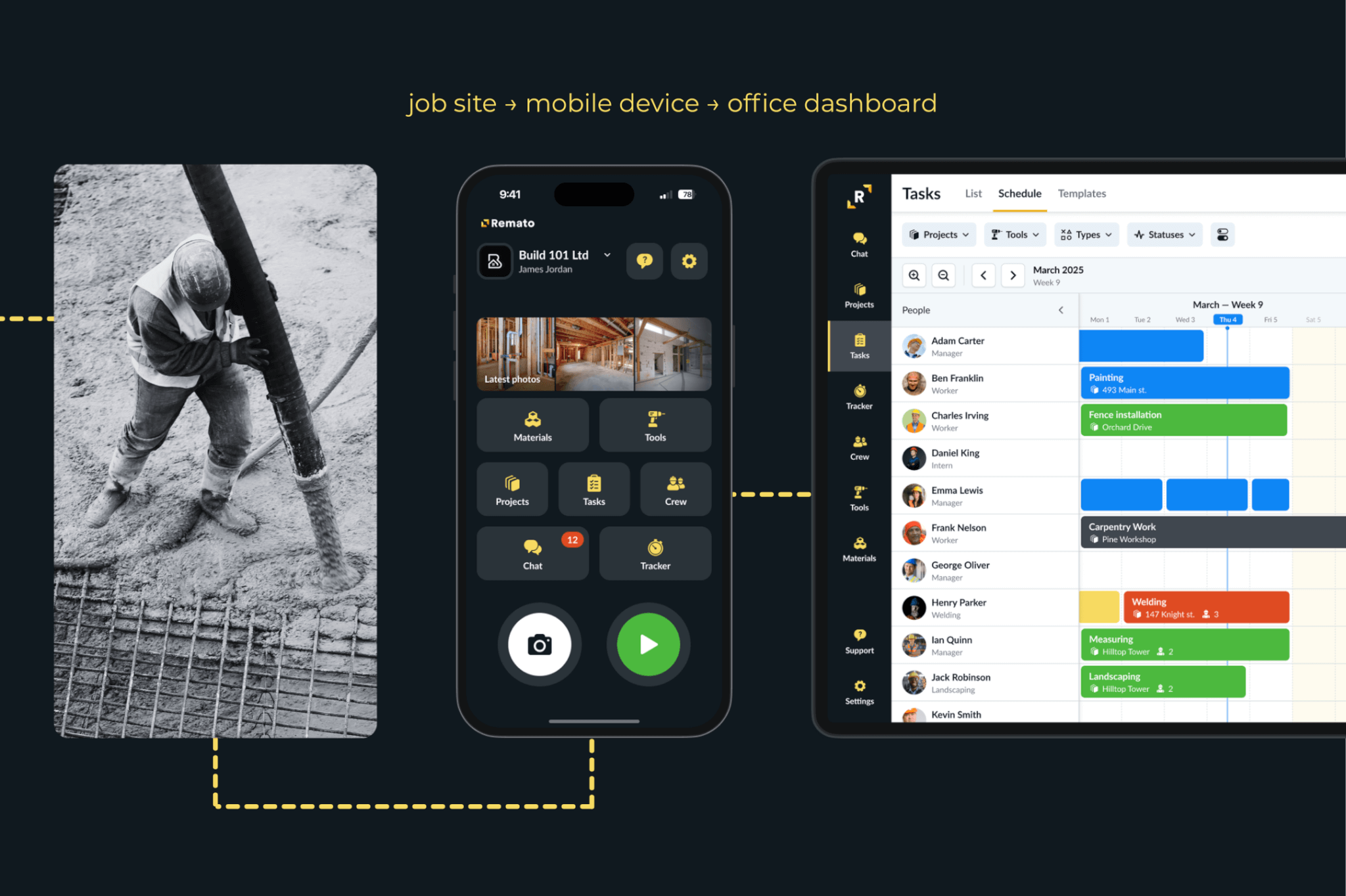
These gains reinforce each other. Better data improves planning. Better planning reduces surprises. Reduced surprises free up cash and attention for growth.
The best time to modernize was last season. The second-best time is today. Start with an easy win like time tracking and task clarity. Then expand into quality, documents, and budgets.
Furthermore, consider evaluating a platform built specifically for construction teams. Remato focuses on fast setup, field-first workflows, and clear visibility for managers and owners. You can explore how it supports subcontractors and growing contractors here.
Your competitors are not adopting construction software for the sake of trend, they are doing it because it gives them faster visibility, fewer mistakes, clearer schedules, stronger profits, and happier crews. The industry is moving toward digital-first workflows, and those who delay risk being left behind. Whether you start with simple time tracking or roll out a full project management system, the benefits compound quickly. Now is the time to take the first step, streamline your operations, and give your business the same competitive edge others are already using to win more projects.