{{ post.date }}
{{ post.readTime }}

Managing a single construction site is straightforward: you walk the site, talk to the foreman, and see progress with your own eyes. Once you are responsible for multiple sites at the same time, this approach no longer scales.
Most owners try to compensate by visiting sites more often and asking for constant updates. This isn’t a trust issue. It happens because there is no consistent, reliable visibility across projects.
At any given moment, owners need clear answers to a few basic questions:
Verbal updates and scattered messages can’t provide this clarity. Photos sent in chat apps lack context, spreadsheets are outdated almost immediately, and weekly reports arrive after problems have already become expensive.
To manage multiple sites without being everywhere, owners must shift from managing by physical presence to managing by information. That means having daily visibility into labour, time, tasks, completed amounts, and job photos that confirm progress and quality.
When this information is structured and available consistently from every site, owners can make decisions without constant site visits, intervene earlier, and stay in control as the business grows.
The goal isn’t to stop visiting sites. The goal is to visit sites by choice, not because you’re missing information.
Verbal updates work when you manage one site and speak to the same people every day. Once you run multiple sites in parallel, they quickly become unreliable. Information is filtered, simplified, or delayed, often without bad intentions. “We’re almost done” can mean very different things depending on who says it and when.
WhatsApp feels like a solution at first, but it breaks down as soon as volume increases. Messages arrive out of order, important updates are buried between unrelated chats, and photos lack context. A picture sent without a task, location, date, or quantity doesn’t tell you what was actually completed—only that something happened.
The bigger problem is that verbal updates and messaging apps don’t answer the core management questions owners need clarity on:
Instead, owners are forced to interpret fragments of information and fill the gaps themselves. That leads to follow-up calls, unnecessary site visits, and late decisions. By the time an issue becomes obvious, it has usually already affected time, cost, or quality.
Another hidden risk is accountability. When updates are verbal or scattered across chats, there is no single source of truth. Tasks are “understood” rather than tracked, progress is assumed rather than verified, and disputes become harder to resolve later.
As the number of sites grows, the problem isn’t communication volume—it’s lack of structure. Without a consistent way to track time, tasks, completed work, and visual proof, owners end up managing by instinct instead of facts.
This is why verbal updates and WhatsApp don’t scale. They create activity, not visibility.
Construction owners don’t need more reports. They need the right information, early enough to act. Daily visibility is not about micromanaging sites; it’s about catching problems while they are still small.
On a daily basis, owners should be able to see five things for every active site:
This information does not need to be perfect, polished, or long. It needs to be consistent, structured, and comparable across all sites. When every project reports differently, owners spend their time interpreting data instead of managing the business.
With this level of daily visibility, owners can quickly scan multiple sites, identify which ones are stable and which need attention, and decide where to intervene. Site visits become intentional, not reactive.
Daily visibility isn’t about control for its own sake. It’s about making fewer assumptions and better decisions.
On their own, time tracking, task lists, quantities, and job photos don’t give owners control. The value comes from how they connect. When these elements are linked, they create a clear and objective picture of what is actually happening on site.
Each piece answers a different management question:
When these elements are tracked separately, owners are forced to guess. A site may show high labour hours but little progress, or tasks marked “done” without evidence. This is where overruns quietly begin.
When they are connected, the picture becomes clear. A completed task is supported by:
This turns daily site activity into verifiable progress, not opinions or assumptions.
For owners managing multiple sites, this connection is critical. It allows quick comparisons between projects, early detection of inefficiencies, and fact-based decisions about where to intervene. Instead of asking, “Is this site on track?”, the data answers the question directly.
This is how owners move from chasing updates to managing by evidence, and how multiple sites can be controlled without constant site visits.
Managing multiple sites efficiently is not about spending more time reviewing information. It’s about reviewing the right information in the right order. When site data is structured and consistent, a daily review can take minutes, not hours.
A good daily review always starts the same way: by exception, not by detail. Most sites on most days don’t need intervention. The goal is to quickly identify the ones that do.
For each active site, owners should be able to scan three things:
This review is not about reading reports line by line. It’s about spotting patterns. Sites usually fall into three categories:
Only the last category requires immediate attention. Everything else can wait.
When owners review sites this way, site visits become targeted. Calls are made with clear context. Decisions are faster because the facts are already visible.
A 10–15 minute daily review doesn’t reduce control. It increases it, because problems are identified early instead of discovered too late.
At a certain point, managing multiple sites with calls, chats, and spreadsheets stops being a process and starts being a workaround. The issue isn’t that owners don’t have enough information — it’s that the information is scattered, inconsistent, and disconnected.
This is where software plays a role. Not as “construction tech”, but as a system that connects daily site activity into one view.
The right software doesn’t replace site management. It supports it by making sure that:
Most importantly, all of this information lives in one place, structured the same way for every site.
Without that structure, owners are forced to do the work themselves: chasing updates, interpreting messages, and filling gaps mentally. With a system in place, the daily review becomes straightforward. You’re not asking “What’s going on here?” — you’re deciding “Do I need to act?”
Good site management software shares a few common characteristics:
When software is used this way, it doesn’t create distance between the office and the site. It reduces noise and removes guesswork. Owners stop managing by instinct and start managing by facts they can trust.
The result isn’t fewer site visits because of technology. It’s fewer unnecessary site visits because visibility is already there.
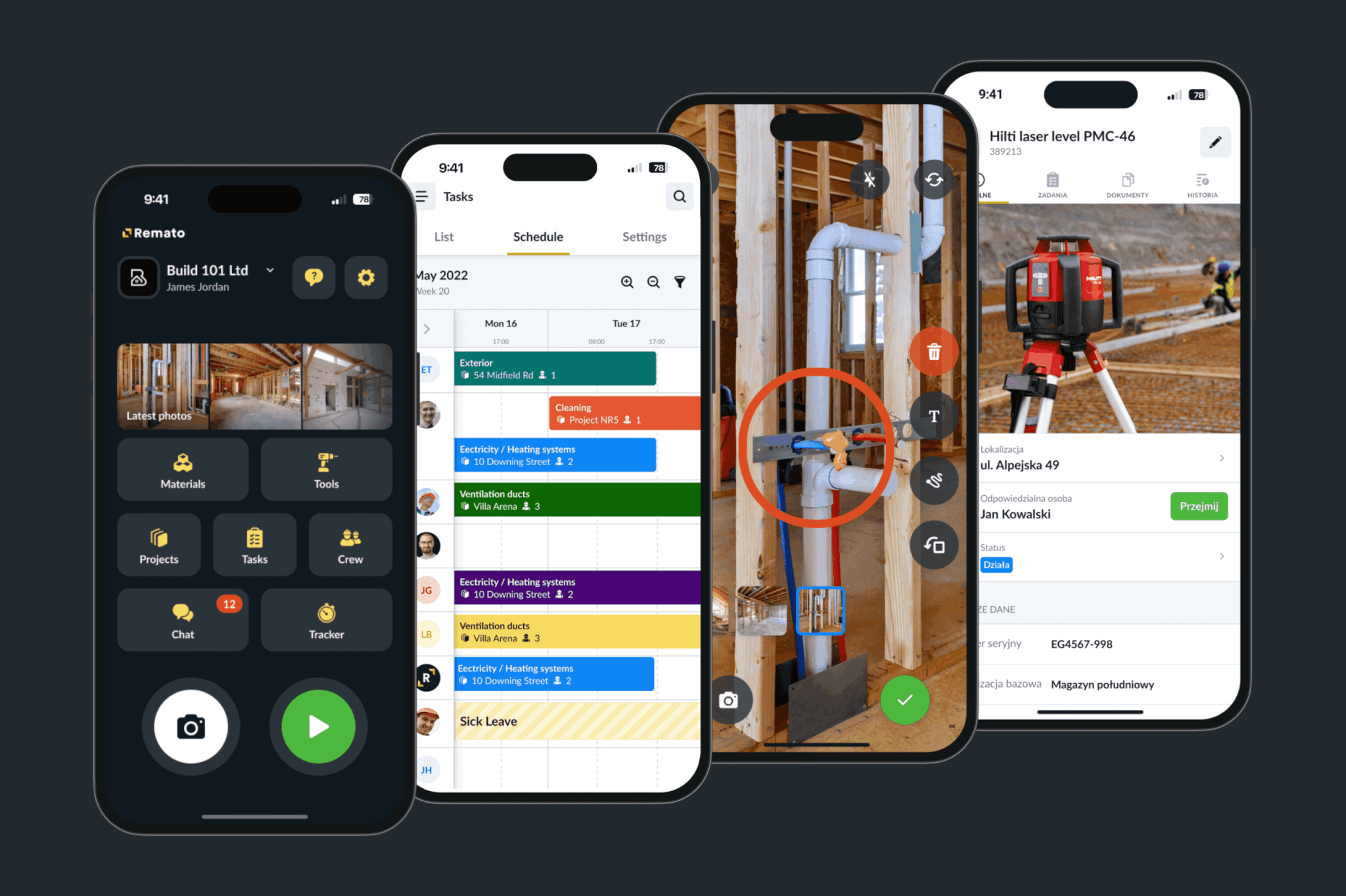
If your goal is to manage multiple sites without being everywhere, you need a system that delivers the information owners rely on most, not just more reports or disconnected data.
Remato is designed for exactly that challenge. It brings together the core site-level inputs that give owners real visibility.
What makes Remato especially useful for owners managing multiple sites is that all of these elements are connected, not tracked in isolation.
Remato is built for field use, meaning daily updates come from the people actually doing the work in a way that does not feel like extra admin. That is what turns structured data into reliable site visibility.
In short, Remato does not just collect information. It helps you see the right information so you can manage by facts instead of assumptions.
Yes, but daily does not mean detailed. Owners need a small set of consistent data points every day to spot issues early. Weekly updates arrive too late, and ad-hoc updates create gaps. Daily visibility allows you to intervene when problems are still cheap to fix.
No, if it is done correctly. Micromanagement happens when information is unclear and owners have to keep asking questions. Clear tasks, time tracking, quantities, and photos reduce follow-up, because expectations and progress are visible to everyone.
Foremen usually resist reporting because it feels like extra admin. When reporting is built into daily work and kept simple, it saves time. Taking a few photos and updating task status is faster than answering repeated calls from the office.
They work at very small scale. Once you run multiple sites, information becomes scattered, outdated, and hard to compare. WhatsApp shows activity, not progress. Spreadsheets show numbers, not reality. Neither creates a reliable source of truth.
Less than most owners think. The goal is not perfect data. It is consistent data. Time per site, clear tasks, basic quantities, and a few relevant photos are enough to give strong daily visibility.
You cannot be everywhere, and you do not need to be. The owners who successfully manage multiple construction sites are not the ones who visit most often. They are the ones who see what matters early and clearly.
When time, tasks, completed quantities, and job photos are tracked consistently, site activity turns into usable information. Decisions become faster. Problems surface earlier. Site visits become purposeful instead of reactive.
Managing multiple sites is not about more control. It is about better visibility. With the right structure and the right tools, owners stop chasing updates and start managing by facts they can trust.
That is how construction businesses grow without losing control.